 |
This page is about the game itself. For an overview of Fallout-related articles, see Portal:Fallout. For an overview article of the Fallout series, see Fallout series. For the TV series, see Fallout (TV series). |
|---|
Fallout: A Post Nuclear Role Playing Game is a computer role-playing game developed by Interplay Entertainment and its division Dragonplay (later Black Isle Studios). It was published on October 10, 1997.[1][2] The game received a direct sequel, Fallout 2.
Gameplay
Fallout is a CRPG, or computer role-playing game, with turn-based combat and a pseudo-isometric view, often described as a trimetric perspective.
Character creation and advancement
The player character has primary stats, traits, skills and perks - all numerical values which determine actions' chances of success according to mathematical formulas, as well as derived statistics such as Hit Points. Beginning stats are chosen during initial character creation.
Experience Points are awarded for successful completion of actions. Acquiring enough Experience Points causes the player character to level up, upon which skill points are distributed by the player and an additional perk chosen.
Character attributes
Fallout uses a character creation system called SPECIAL. SPECIAL is an acronym of Strength, Perception, Endurance, Charisma, Intelligence, Agility, and Luck. These are the seven basic attributes of every character in the game. They are used to determine the skills and perks of the given character.
Fallout was originally intended to use the GURPS system, but licensing issues caused the project to transition to the SPECIAL system late in the development process.[3]
Skills
There are 18 different skills in the game. They are ranked from 0% to 200%. The starting values for those skills at level one are determined by the player's seven basic attributes or SPECIAL, but most of those skills would fall between 0% and 50%. Every time the player gains a Level, they will be awarded skill points to be used to improve their skills, equal to five points plus twice their Intelligence. The player may choose to "Tag" three of the 18 skills. A tagged skill will improve at twice the normal rate.
- Six combat skills: Small Guns, Big Guns, Energy Weapons, Unarmed, Melee Weapons, Throwing.
- Eight active skills: First Aid, Doctor, Sneak, Lockpick, Steal, Traps, Science, Repair.
- Four passive skills: Speech, Barter, Gambling, Outdoorsman.
Books found throughout the game world can also improve some of those skills permanently, although books are scarce early in the game. However, after a skill reaches a certain Level, books no longer have any impact on that skill. Some non-player characters can also improve Skills via training. How high skills can be developed is affected by the character's attributes—a character with a low Intelligence will not be able to boost their Science rating as high as a character with high Intelligence, for example.
Some skills can also be improved while having certain items equipped. For example, equipping lock picks would improve lockpicking skills. Chems can also temporarily boost the player character's skills; however, they often have adverse effects such as addiction and withdrawal. As skills grow higher in rating, they begin to cost more skill points to increase.
Traits and perks
At character creation, the player may choose two different traits and perks for their character. Traits are special character backgrounds. Most traits have profound effects on gameplay. A trait normally contains one beneficial effect and one detrimental effect. They are listed under perks in the character sheet. Once a Trait is chosen, it is impossible to change, except through the Mutate! perk that lets them change one trait, one time.
Recruitable non-player characters
A diverse selection of various recruitable non-player characters can be found to aid the player character in the post-apocalyptic wasteland. Unlike in Fallout 2, there is no limit to the number of NPCs that may be recruited in Fallout. Their statistics and armor remain unchanged throughout the entire game; only their weapons may be upgraded.
- Ian is a former caravan guard that can be found in Shady Sands and is the first recruitable non-player character that the player character typically meets. He is an experienced traveler and gunman. Ian can equip any pistol or 10mm SMG (including "large handguns"), and wears a leather jacket.
- Dogmeat is the only non-human non-player character that can be recruited. Dogmeat can be found in Junktown, outside of Phil's house, preventing him from entering his house. The dog may be attracted by either wearing a leather jacket or feeding the dog an iguana-on-a-stick. After that, he will follow the player character.
- Tycho is a former Desert Ranger, now living in Junktown. He can wield rifles, shotguns, and spears.
- Katja is a disillusioned Follower of the Apocalypse that may be recruited in the library in the LA Boneyard. She can fight unarmed and wield SMGs.
Story
Setting
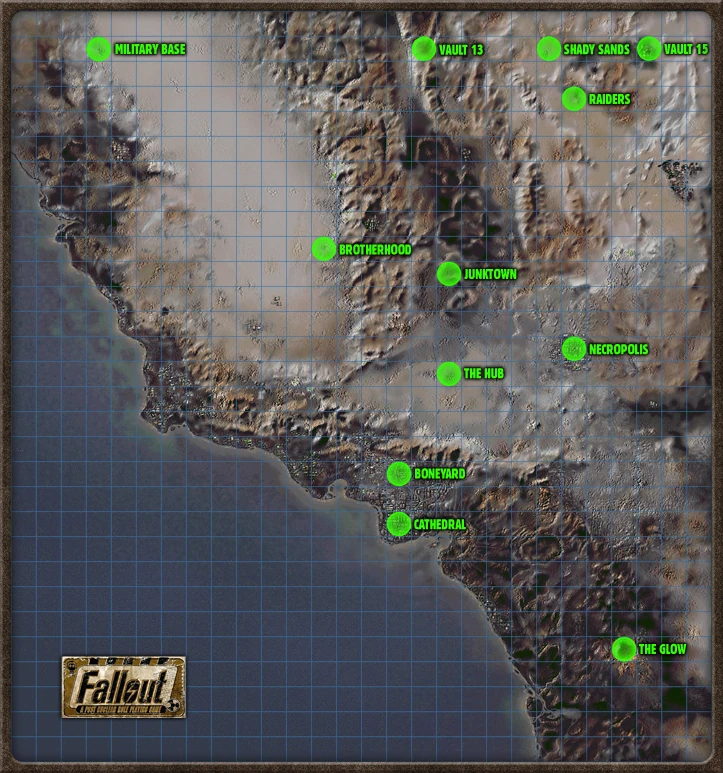

Southern California, the world map
The game is set in a post-apocalyptic world following the Great War, a nuclear war that occurred on October 23, 2077. The war lasted less than two hours but caused immense damage and destruction. Before the Great War came the Resource Wars, during which the United Nations had disbanded, and Canada was annexed.
The game takes place in 2161, 84 years after the Great War in Southern California. The events in Fallout take place 59 years after Fallout 76, 36 years before Fallout Tactics, 47 years before Fallout: Brotherhood of Steel, 80 years before Fallout 2, 116 years before Fallout 3, 120 years before Fallout: New Vegas, and 126 years before Fallout 4. Chronologically it is the second game in the series after Fallout 76.
Plot
The protagonist is known as the Vault Dweller. They are described by creator Timothy Cain as a 20-year-old who has grown up in a vault and are the third generation of dwellers, in contrast to the elders who have lived in there for around 80 years. The Vault Dweller may also be one of the three pre-made characters instead, Albert Cole, Max Stone and Natalia Dubrovhsky.
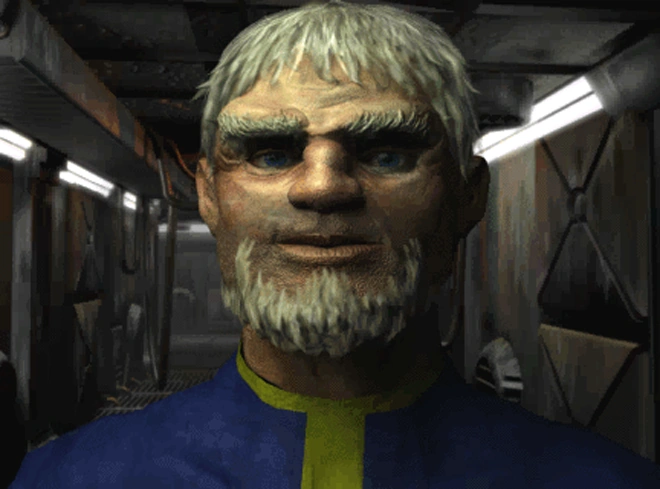

Vault 13 overseer sends the Vault Dweller on a mission to obtain a water purifier chip.
The story begins in Vault 13, the Vault Dweller's home. Vault 13's water chip, a computer chip responsible for the water recycling and pumping machinery, has broken. Vault 13's overseer tasks the protagonist with finding a replacement. They are given a portable device called the Pip-Boy 2000 which keeps track of mapmaking, quest objectives, and various bookkeeping aspects. Armed with the Pip-Boy 2000 and meager equipment, the protagonist is sent out into the remains of California to find another water chip.
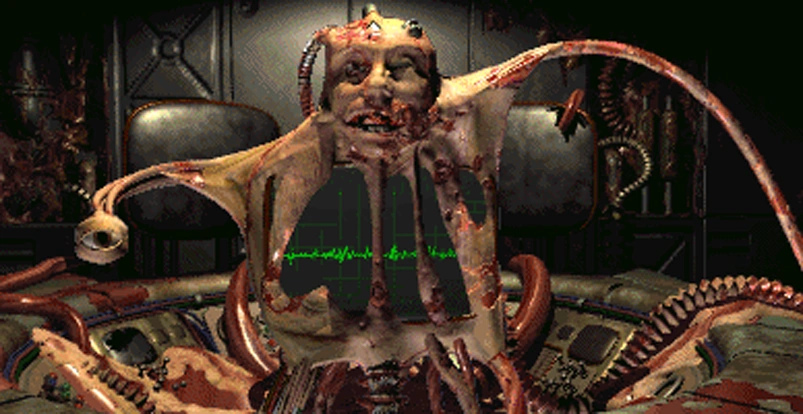

The Master who believes turning humanity into super mutants will bring them closer together.
The player character initially has 150 days (4 to 5 months, according to the overseer) before the Vault's water supply runs out. This time limit can be extended by 100 days if they commission merchants in the Hub to send water caravans to Vault 13. Upon returning the chip, the Vault Dweller is then tasked with destroying a mutant army that threatens humanity. A mutant known as "The Master" (previously known as Richard Grey) has begun using a pre-War, genetically engineered virus called Forced Evolutionary Virus to convert humanity into a race of "super mutants" and bring them together in the Unity, his plan for a perfect world. The player character has to kill him and destroy the Military Base housing the supply of FEV, thus halting the invasion before it can start.
If both objectives are not completed within 500 game days, the mutant army will discover Vault 13 and invade it, bringing an end to the game. This time limit is shortened to 400 days if Vault 13's location is divulged to the water merchants. A cinematic cutscene of mutants overrunning the Vault is shown if the task to stop the mutant army is failed within this time frame, indicating the player character has lost. If they agree to join the mutant army, the same cinematic is shown. With version 1.1 of the game, the time limit for the mutant attack on Vault 13 is nearly eliminated (to a maximum of thirteen in-game years), allowing player characters to explore the game world at their leisure.
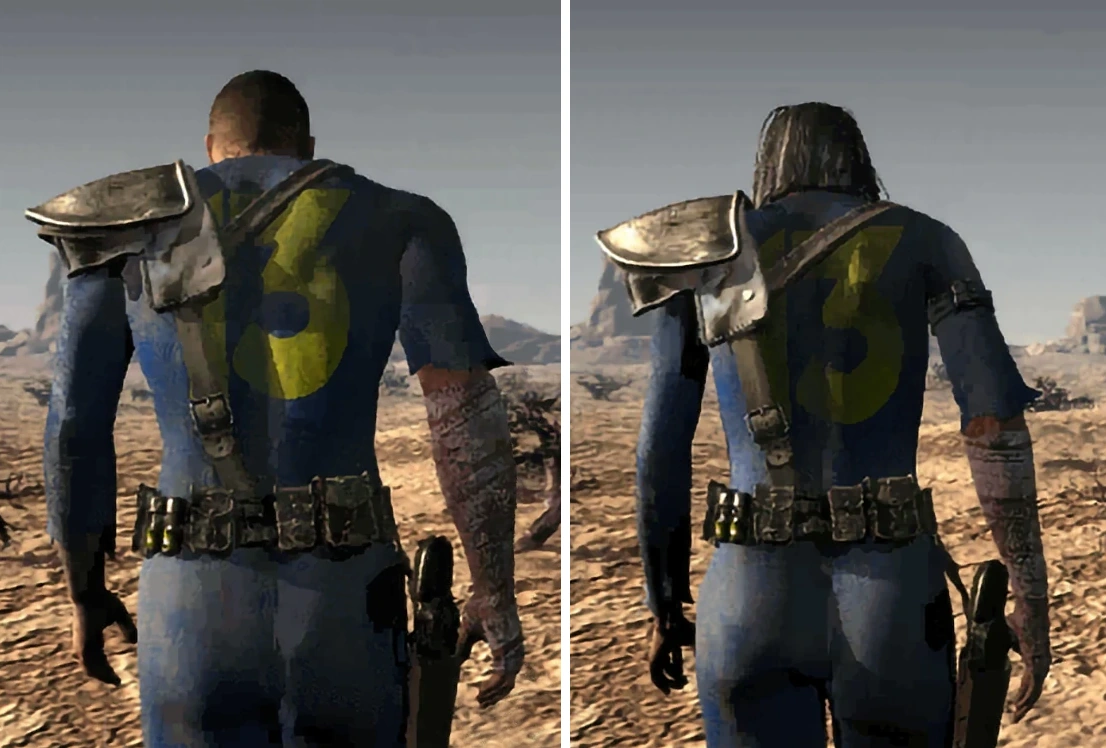

Exiled for the "good of the vault", the Vault Dweller walks into the desert.
The player can defeat the Master and destroy the super mutants' military base in either order. When both threats are eliminated, a cutscene ensues in which the player character automatically returns to Vault 13. There they are told that they have done great things for the Vault and all of humanity but if they came back everyone would want to leave the Vault and that the Vault Dweller must leave for the good of the Vault. Thus they are rewarded with exile into the desert, for, in the overseer's eyes, the good of the Vault.
There is an alternate, non-canonical ending (available if the player character has the "Bloody Mess" trait, has accrued significant negative Karma throughout the game, or performs the action manually) in which the Vault Dweller shoots the overseer.
After the end of the game, the exiled Vault Dweller eventually found Arroyo, the starting point for Fallout 2. The Chosen One, the protagonist in Fallout 2, is the descendant of the Vault Dweller.
Endings
There are some ending variations for the fates of people and locations.
Locations
- Vault 13: The Vault Dweller's home. The first quest in the game is to find a replacement for the vault's broken water purification chip. None of the inhabitants are permitted to leave the vault, under the leadership of the vault's overseer, who is dedicated to protecting and sheltering them. Vault 13 was probably located under Mt. Whitney, as it roughly matches the location of the mountain. Vault 13 may also refer to a mountain in Indian Wells Valley, within the bounds of the Naval Air Weapons Station at China Lake, known as B-Mountain. The mountain looks very similar to illustrations of the location in the game and is rumored to have a large underground research center inside.
- Vault 15: This vault was once occupied by an enormous number of people of very different ideologies and cultures. The overcrowding and the diversification led to four different groups leaving, three of them forming each one raiding group - the Khans, the Vipers, and the Jackals - and one of them settling down and founding Shady Sands. Vault 15 is now lair to several mutated animals. A water purification chip is nowhere to be found here.
- Shady Sands: A group of former Vault 15 inhabitants has founded a small village between Vault 13 and Vault 15. Shady Sands is led by Aradesh, who asks the Vault Dweller to help get rid of the radscorpions who are threatening the village. Here, the Vault Dweller can recruit Ian, an experienced traveler and gunman, to their group. It is also possible to "recruit" Tandi, the daughter of Aradesh, by not returning her to town after her kidnapping. An obelisk in the center of the city has the inscription "In remind of hope and peace."
- Khan Base: A clan of raiders known as the Khans, led by a man named Garl, have set up a camp near Shady Sands. Tandi, Aradesh's daughter, is eventually kidnapped by the camp's raiders, and it is up to the Vault Dweller to save her, choosing from a variety of methods.
- Junktown: Surrounded by piles of wrecked cars, Junktown is run by the shop owner Killian Darkwater, who is also the sheriff and grandson of the town's founder. Junktown's gates are closed in the night, and drawing weapons is not allowed except in self-defense. Gizmo, the town's casino owner, wants Killian dead because he "cramps [my] business." The player character can choose to either help Killian or Gizmo. The Vault Dweller can also recruit Tycho, a ranger, and Dogmeat, a wild dog, to their group.
- The Hub: As a major commercial town, the Hub is the most quest-filled location in the game. It is divided into several districts, each one controlled by a powerful group of people: the Water Merchants, the Crimson Caravan and the Far Go Traders. Here the Vault Dweller can send water merchants to Vault 13 to extend the time limit in which they must find a water chip.
- Necropolis: The remains of what was once Bakersfield, California. Overrun by ghouls and containing a vast sewer system, Necropolis is the aftermath of Vault 12. Vault 12 was designed by the Enclave so that its door could not close and the vault's occupants would be exposed to high doses of radiation. This led to the transformation of its inhabitants into ghouls after the Great War. The ghouls were divided into three groups: the surface dwellers, who are the most numerous, and paranoid about non-ghouls and outsiders; the glowing ones, heavily irradiated ghouls, rejected even by their own, and the so-called underground ghouls, living in the city's sewers. It is here that the Vault Dweller finds the water chip while observing an unusual super-mutant invasion, which may be a serious threat to humanity's future.
- Boneyard: The Boneyard, also known as the Angel's Boneyard, is the remaining portion of the Los Angeles cityscape. This is one of the later towns that the Vault Dweller may visit, receiving upgrades for end game equipment: the turbo plasma rifle and hardened power armor. The player character may also recruit Katja here.
- Lost Hills: This bunker is the headquarters of the Brotherhood of Steel, shown as "Brotherhood of Steel" in the Pip-Boy 2000, an organization with roots in the US military and government-sponsored scientific community from before the Great War. The outpost consists of four underground levels; with level one closest to the surface and level four the furthest underground. Level zero is the on-ground entrance.
- The Glow: Formerly known as West Tek Research Facility, The Glow is now an irradiated ruin. It is here that experiments were conducted on laser and plasma weapons, and the development of the FEV and power armor took place. The Glow is controlled by a mainframe called "ZAX." It is the Vault Dweller's objective to retrieve a piece of evidence for the Brotherhood of Steel, which is a holodisk left by a fallen Brotherhood of Steel member, that proves he entered the location. The difficulty in this assignment is that The Glow is highly radioactive, and the player character must consume anti-radiation drugs to survive their visit. A player character unaware of this zone's high radiation levels would find themselves quickly succumbing to radiation poisoning.
- Mariposa Military Base: This former military base is where the research was conducted on FEV (which was previously conducted in the West Tek Research Facility). This is where new super mutants are created.
- The Cathedral: The Cathedral is the place where the Children of the Cathedral organization, which is a façade for the Master's plans, can be found. Beneath the Cathedral lies a secret vault, wherein the Master resides.
Development
Fallout started out as the brainchild of Timothy Cain, who began development of the game alone for a year before being assigned two others, a scripter and a coder.[4] Cain described Fallout as a "B-tier project" that had "problem" employees assigned to it, although he found most of the employees fine to work with and felt the real problem were their managers. Fallout was almost cancelled three times, and Cain was told that it was not a "worthwhile" project to develop.[5]
The designers of Fallout proposed many ideas for the game's title. The earliest working title they considered was Vault 13 (in full, Vault 13: A GURPS Post-Nuclear Adventure); however, this title was deemed ineffective at communicating the game's genre, and so a different name had to be chosen. The designers proposed many titles, including Aftermath, Survivor, and Postnuclear Adventure,[4] but they eventually agreed to name it Armageddon. However, they found out that another Interplay project was going to use that title, so they were obligated to switch again, and Fallout was the team's favorite among the remainder.[6]
The game was initially intended to use Steve Jackson Games' GURPS system, but when Interplay Entertainment made the decision to drop GURPS on February 12, 1997,[3][7] it created its own system, SPECIAL.
Fallout is seen as the "spiritual successor" to Interplay Entertainment's classic 1987 CRPG Wasteland.
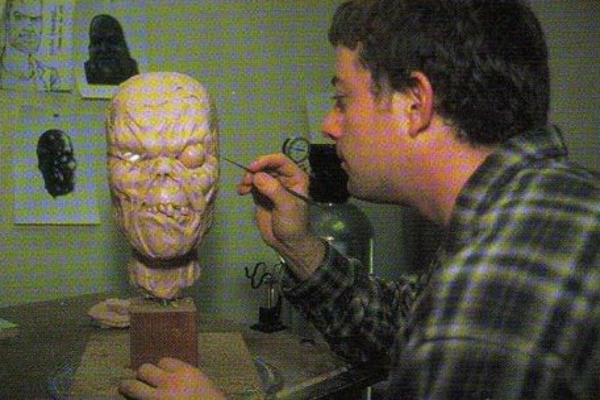

The creation of a talking head
Although Fallout is an isometric game, the developers were open to the idea of making Fallout a fully 3D game, but the limitations of 3D games around 1996 influenced the game to remain isometric.[8] Additionally, due to the technology available at the time as opposed to 3D character models, talking heads were constructed with clay. They were scanned, textured and animated. This allowed 21 characters in the game to be shown with great facial detail compared to the sprites of other characters.
Although the game was intended to release in the summer of 1997, a memory overwrite bug causing random crashing delayed the game a few months.
At the Game Developers Conference in San Francisco, held from March 5–9, 2012, Tim Cain held a presentation about the original Fallout's early development stages. Afterward, a post-mortem document was released which describes the game's development progress and shows how the team overcame the many difficulties they faced from '94 till its release in September '97. It also provides several early concept art images.[9]
Fallout has a vision statement listing key points about what the developers wanted Fallout to be. Fallout was also inspired by the Hard-Boiled comic book mini-series by Frank Miller and Geoff Darrow, as well the film The City of Lost Children starring Ron Perlman, the narrator of the Fallout openings.
Availability
New boxed editions of the game were published several years after the game's release, usually included on one DVD together with Fallout 2 and Fallout Tactics. They were bundled on Fallout Trilogy (2004), Fallout Anthology (2015) and Fallout Legacy Collection (2019).
Fallout can be purchased on Steam and GOG.com (DRM-free version). Interplay struck a deal releasing their own DRM-free copies of Fallout, Fallout 2, and Fallout Tactics as a set.
This was not always the case, however; in early 2014, Steam and GOG.com removed Fallout, Fallout 2 and Tactics from purchase availability as a result of the license changing hands. Bethesda stated that they would be bringing the games back to Steam, but made no confirmation as to whether or not they would be returning to other distribution platforms.[10] Sometime around June 2014, the games returned to Steam, while in August 2015 they became available again through GOG.com.
On September 30, 2017, the release date of the game in 1997, as a celebration of Fallout's 20th anniversary, Bethesda gave away Fallout for free on Steam until 11:59 p.m. Pacific time.[11]
Fallout, Fallout 2 and Fallout Tactics were all given for free when Fallout 76 was pre-ordered on PC.
Developers
The Fallout developer team had nearly 100 members (mostly artists). Although most of the team dissolved after Fallout was released, about one-third of them formed Interplay's Black Isle Studios division that was responsible for Fallout 2. Some went on to work on future projects, and several key players left Interplay altogether to form Troika Games.
Music
The game soundtrack for Fallout was composed by Mark Morgan.
International versions
The game underwent censorship in certain international versions, including the removal of all children from the game in some of the European versions (e.g. British and German ones). This censorship was apparently imposed because the game included the possibility of killing children, although this was in no way promoted (on the contrary, the game actively discourages this act, though it remains possible as part of the player character's free will). Among its consequences are unfriendly responses from non-player characters, bounty hunters regularly and repeatedly attacking the player character, and various non-player characters refusing to assist them in their adventure. In addition to being frustrating for many of the game's players, the removal of children from the game is known to have produced a number of bugs.
Marketing
In the Vault Dweller's Survival Guide, Brian Fargo stated that the game had no marketing campaign. Instead, he encouraged the fans to give direct feedback about their games on Interplay's website.[12] The Fallout Demo was released on April 26, 1997.[13]
Demos
A number of demos were made for the game, which features unique content designed specifically to show off the game's systems without spoiling its story including an interactive demo for E3 1996 and public demo.
Reception
Fallout received a Metacritic metascore of 89.[14]
GameSpot gave it an 8.7 and praised the game, but found some aspects of it clunky, feeling, "interaction with nonplayer characters (NPCs) is a bit disappointing. Most of the nonplayer characters in Fallout aren't big on conversation and run around blithely and inconsequentially." They also found some of the NPC companion mechanics frustrating, mentioning, "Unfortunately, these NPC companions tend to take particular delight in blocking doorways or shooting you (and each other) in the back with semiautomatic weapons. You also won't be able to directly access your companions' inventory or otherwise instruct them to give you items or to equip better armor. Give an NPC a key item and you'll have to barter or steal from the NPC in order to get it back."[15]
Behind the scenes
In 1998, a pitch for a Fallout film adapting the video game was created. In 2000, it was announced that it would be developed by Interplay Films. However, the project never came to fruition.
Gallery
![Promotional artwork, which was outsourced or done by Interplay's marketing team. None of the Fallout devs ever saw or approved it.[16]](/wiki/File:Old_FO1_ad.jpg "Old FO1 ad.jpg (2.04 MB)")


Videos
External links
- Fallout on Steam
- Mirror of the official Fallout website at Duck and Cover
- Mirror of the official early GURPS: Fallout website at Duck and Cover
References
- ↑ Article on PC Gamer, October 3, 1997 (archived link)
- ↑ Fallout development log on Interplay.com (archived link)
- ↑ 3.0 3.1 See the background section on Vault 13: A GURPS Post-Nuclear Adventure.
- ↑ 4.0 4.1 "Fallout Could've Been About Time-Traveling, Dinosaurs, and Monkey Murder" - Kotaku, 3/8/2012
- ↑ https://youtu.be/6i8Bx4zYIKQ
- ↑ "The team proposed a bunch of names. We settled on Armageddon for a brief time but found out another Interplay project was going to use that, so had to switch again. Fallout was the team's favorite among the remainder. The other Armageddon was canceled shortly thereafter, but since we had already announced Fallout, it was too late to change back."
Fallout retrospective - ↑ Steve Jackson Games
- ↑ Fallout at 25 Fallout Wiki roundtable
- ↑ Early concept vision document
- ↑ Fallout on Steam article
- ↑ Fallout Anniversary article
- ↑ Vault Dweller's Survival Guide, Page A-7
- ↑ Fallout demo
- ↑ Metacritic - Fallout PC
- ↑ GameSpot review
- ↑ Leonard Boyarsky interview at RPG Codex
 | The contents of this page were partially or entirely copied from Wikipedia, the free encyclopedia, and are therefore licensed under the Creative Commons Attribution-ShareAlike 3.0 Unported License. The original version, its history and authors can be found at the Wikipedia page "Fallout (computer game)." |
|---|