Weather is a gameplay mechanic that has appeared in multiple entries of the Fallout series. While it was initially a purely cosmetic element, later entries have featured certain weather types that affect gameplay and the player character.
Fallout
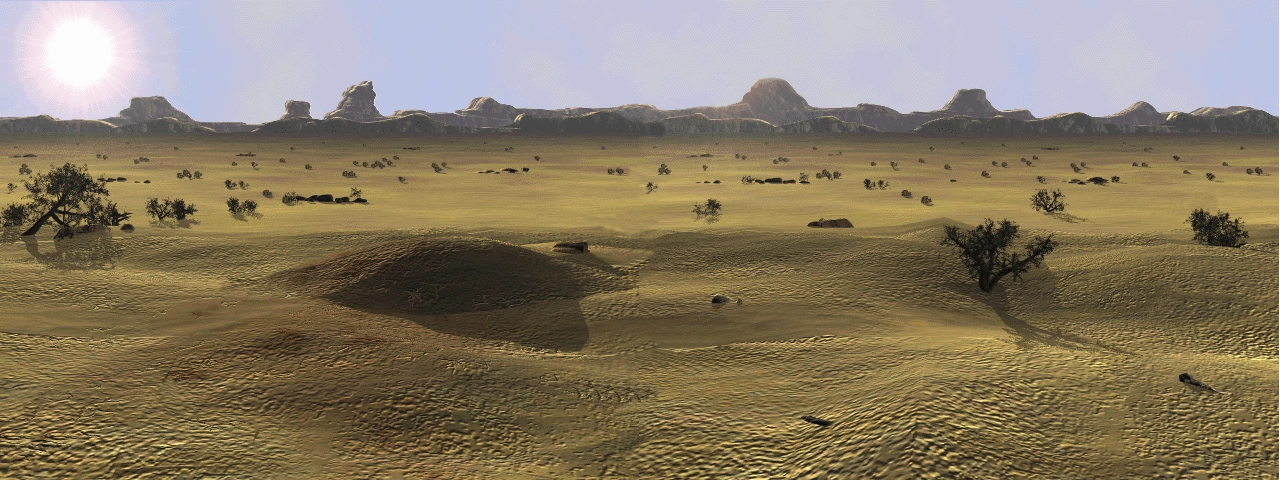
A brief view of a clear sky seen in the game's ending
Some Adytum citizens comment on the likelihood of rain soon, and others note how previous rainfalls have been "glowing."[1] Weather changes are not seen in-game outside of cutscenes or certain backgrounds, where the sky is usually either clear or cloudy.
Fallout 2
The sky as seen in one of the game's character backgrounds
In 2241, the region of northern California is said to be suffering through a drought, the worst dry season in years, following an unusually short rainy season.[2] Despite being relatively sustainable communities, Modoc and the village of Arroyo were hit particularly hard.[3][4] This extreme meteorological occurrence, later estimated to last seven years, influenced the fate of some wasteland inhabitants.[5] A random encounter with a weary fisherman reveals there is apparently a regular "season of storms" that is not seen during the game's timeframe.[6] Weather changes are not seen in-game outside of cutscenes or certain backgrounds, where it is usually either clear or cloudy.
Fallout 3
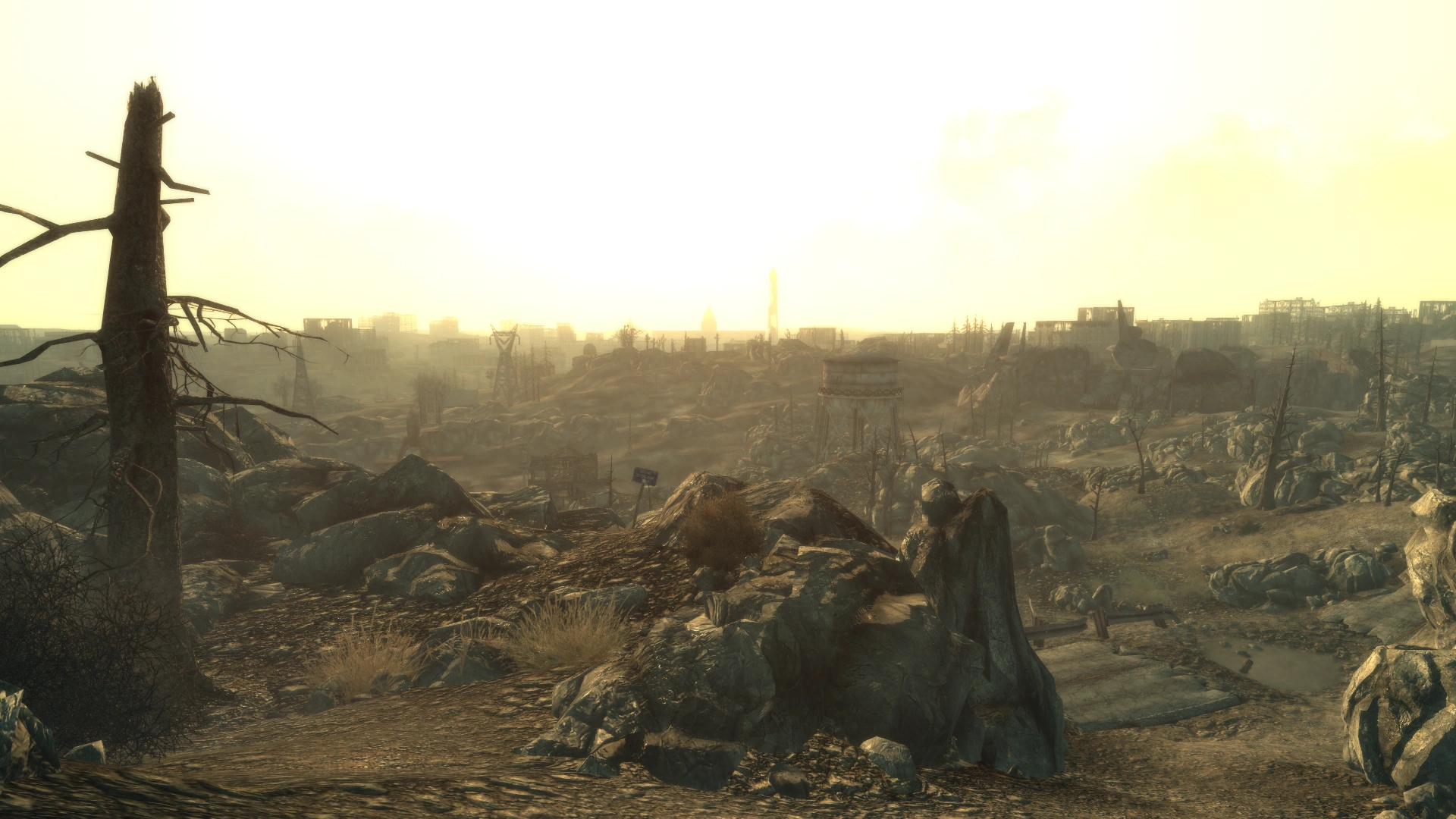
Clear but green skies seen in the DC area
According to citizens of Rivet City, rain is a normal occurrence in the Capital Wasteland in 2277,[7] but it is noted that periods of drought with little rainfall are also common.[8]
Weather in the Capital Wasteland is typically either clear or a cloudy overcast, while there are distinct variations found in the game's add-ons:
- In Operation: Anchorage, the Anchorage Reclamation simulation replicates the appearance of Alaska's cold, snowy landscape, with most NPCs wearing heavy layers and coats, though this has no bearing on the player character's performance.
- In The Pitt, the eponymous area of the Pitt has a sickly orange overcast due to the heavy smog and pollution coming from the city's steel mills.
- In Point Lookout, the eponymous area of Point Lookout's swamplands have a misty/foggy overcast.
 | The following is based on Fallout 3 cut content. |
|---|
The Fallout 3 game files suggest that the game was originally intended to have more dynamic weather, with rain being possible in-game. Several characters in Megaton and Rivet City, including Walter, Colin Moriarty, Harkness, and Vera Weatherly, have an "IsRaining" condition in their AI packages to avoid going outside if it is raining. Due to the final game lacking rainy weather, this condition is never activated and the NPCs' routines are never interrupted.
| End of information based on Fallout 3 cut content |
|---|
Fallout: New Vegas
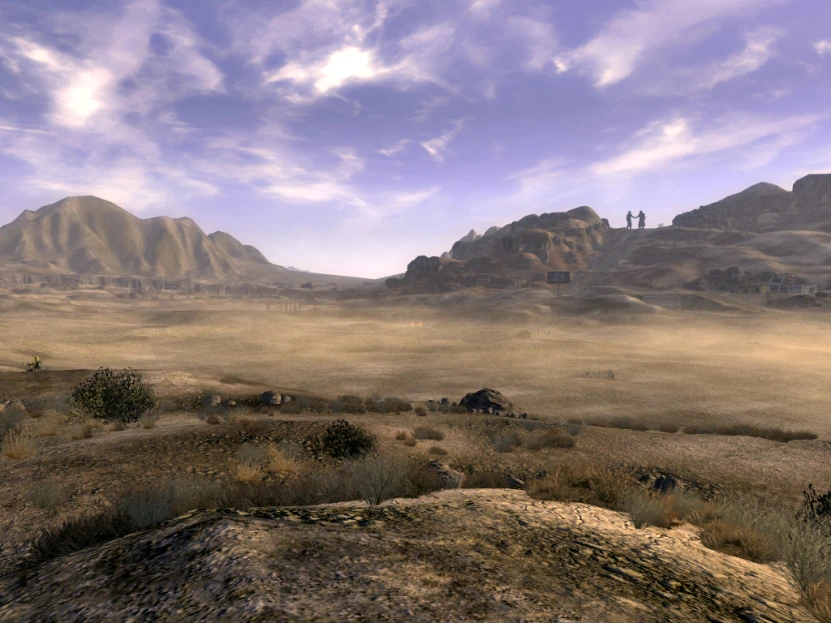
Typical sunny Nevada skies
The Mojave Wasteland is only shown to have clear skies, with some exceptions such as the artificial sandstorm around Hidden Valley at night that is generated by the Brotherhood. The sound of thunder can also be heard upon fast travelling to, or just standing around, Black Mountain. The mutants of Jacobstown claim to prefer the elevated location of the ski lodge near Mount Charleston due to its cooler temperature,[9] and snowflakes can occasionally be observed falling in the area of the ski lodge.
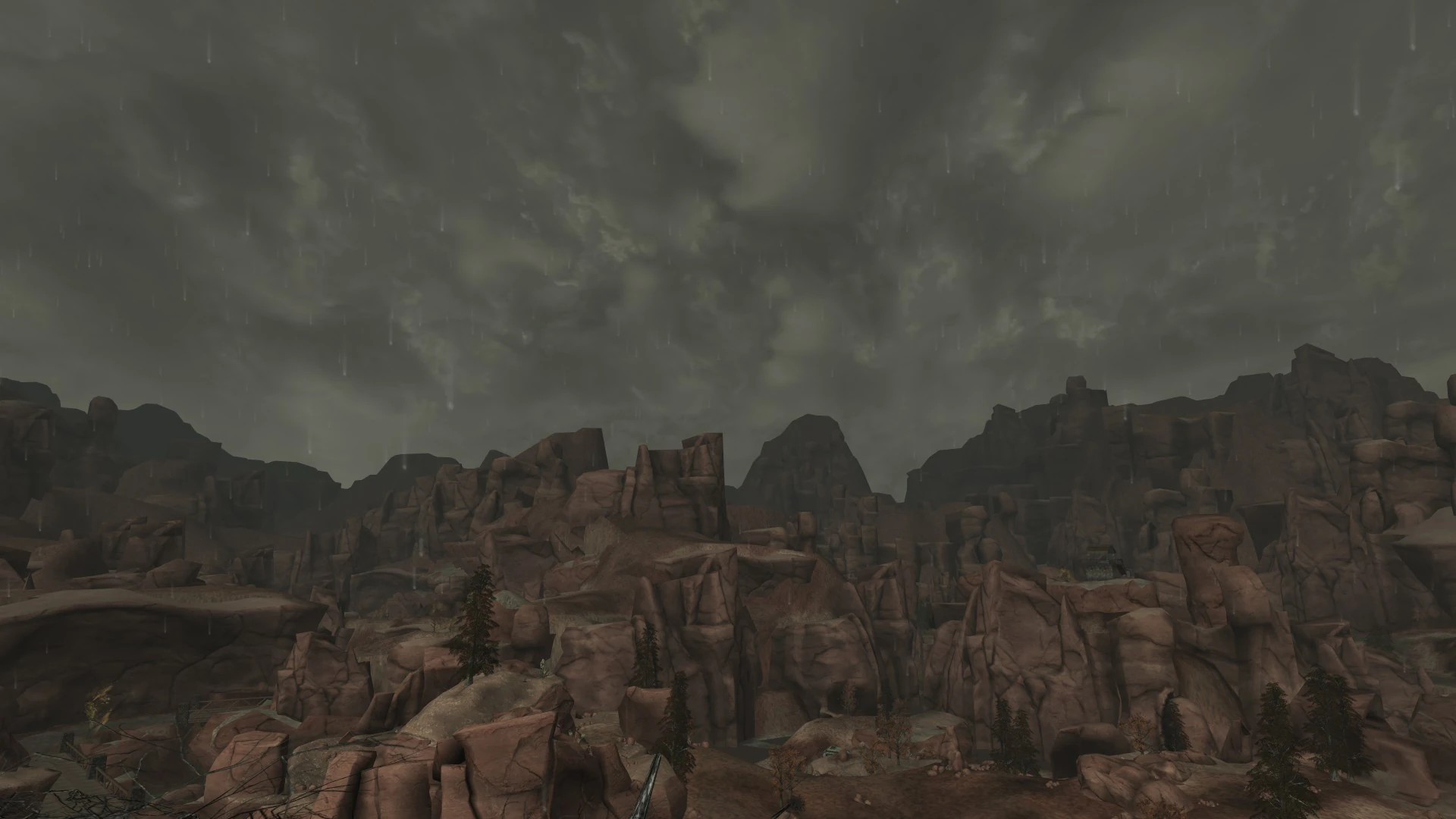
Rain in Zion Canyon
As with Fallout 3, the areas visited during the add-ons offer distinct weather variations:
- In Dead Money, the Sierra Madre has a constant dark-red overcast due to the long-term spread of the Cloud.
- In Honest Hearts, Zion Canyon in Utah has the first case of dynamic weather in the series, including sunny, cloudy, and rainy weather with visible rainfall. A journal entry by Randall Clark also describes an early post-War occurrence of heavy weather around January 2078 that lasted for days and ended in an overcast of glowing snow in the canyon,[10][11] highly resembling a radstorm.
- In Lonesome Road, the Divide has a constant overcast of sandstorms and heavy winds blowing through the gorge due to the catastrophe that created it years prior.
Fallout 4
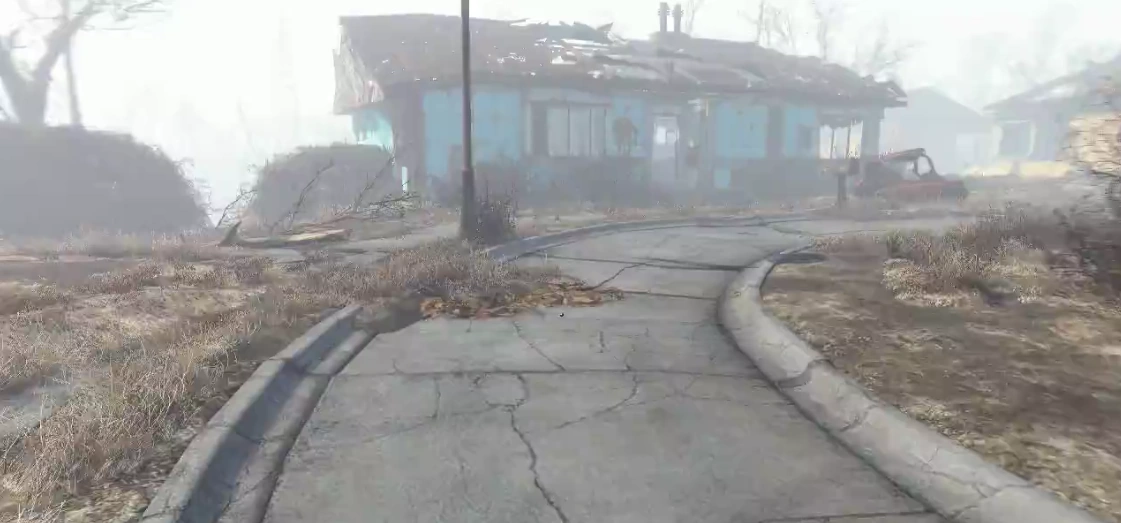
Foggy weather in Sanctuary Hills
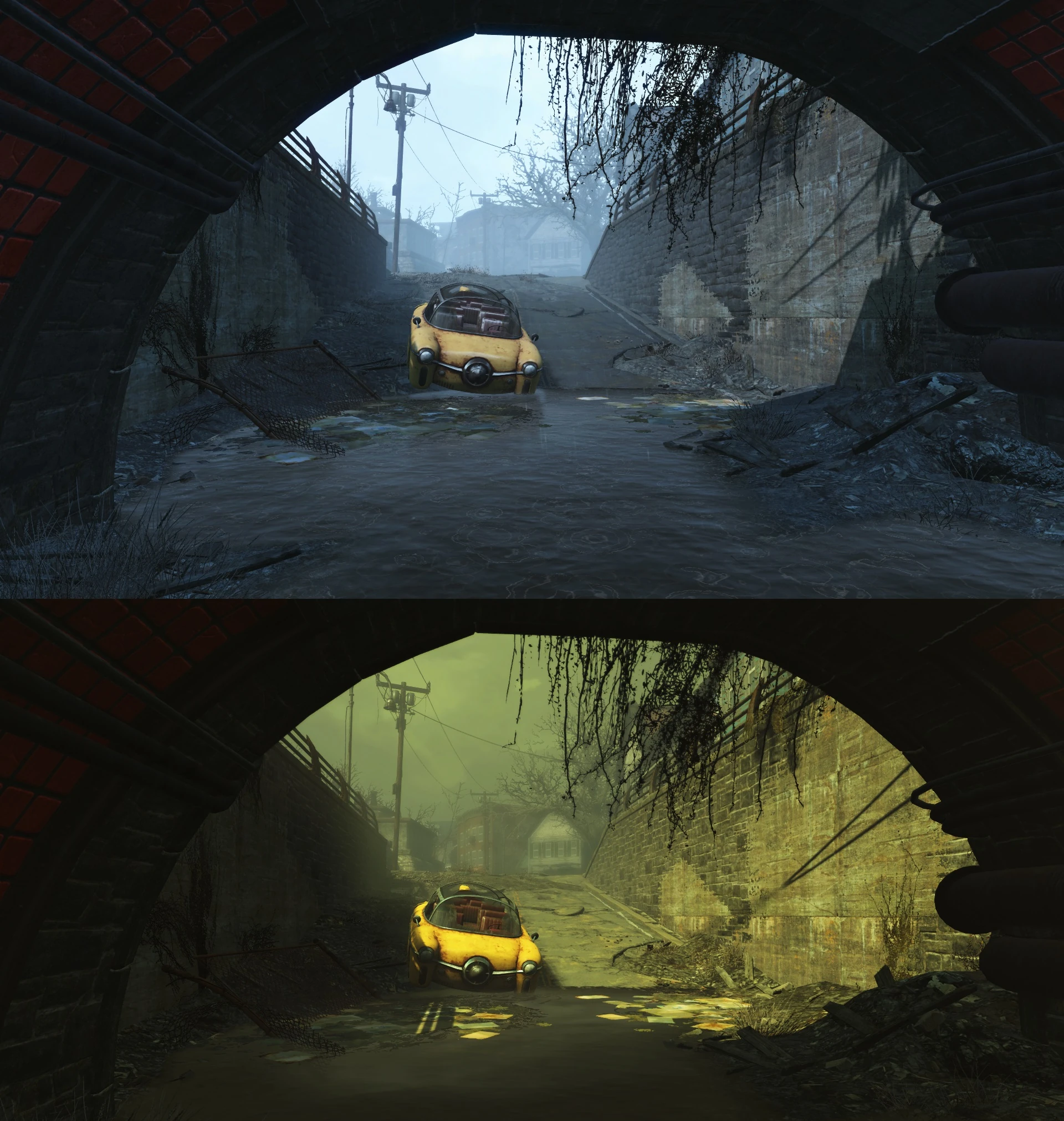
The same location during misty weather (top) and a radstorm (bottom)
Compared to previous locations in the series, the Commonwealth as it appears in Fallout 4 has a much more immersive weather system. The world alternates in real-time between various weather types including clear skies and assorted degrees of overcast weather, including a light mist, heavy fog, and rainfall. Thunderclaps (unrelated to the radiation-emitting lightning from radstorms) are possible during rainy weather. The length of these weather conditions varies and progresses naturally as an in-game day goes on.
While all other weather types are purely cosmetic and harmless, on occasion, a more dangerous radiation storm, also called a radstorm, may ensue. Blowing in from the area known as the Glowing Sea in the southwestern corner of the Commonwealth,[12] during a radstorm, the surrounding area is covered with heavy green fog, and occasional flashes of lightning will inflict small amounts of radiation damage to the Sole Survivor. Despite the presence of these lightning strikes, rain is not a feature of radiation storms. Radiation storms last for about two in-game hours and are comparatively rare in terms of weather conditions.
- In Far Harbor, Mount Desert Island is almost completely blanketed in a unique radioactive phenomenon called the Fog, inflicting low but constant amounts of radiation damage and rendering most areas of it uninhabitable to humans.[13] Rain and radiation storms are also a possible occurrence on the Island as well.
- With the Contraptions Workshop add-on, it is possible to craft one of three types of weather change shell and launch them from firework mortars. The three types allow the player character to directly alter the weather of the Commonwealth between clear skies, rainstorms, and radiation storms.
Fallout 76
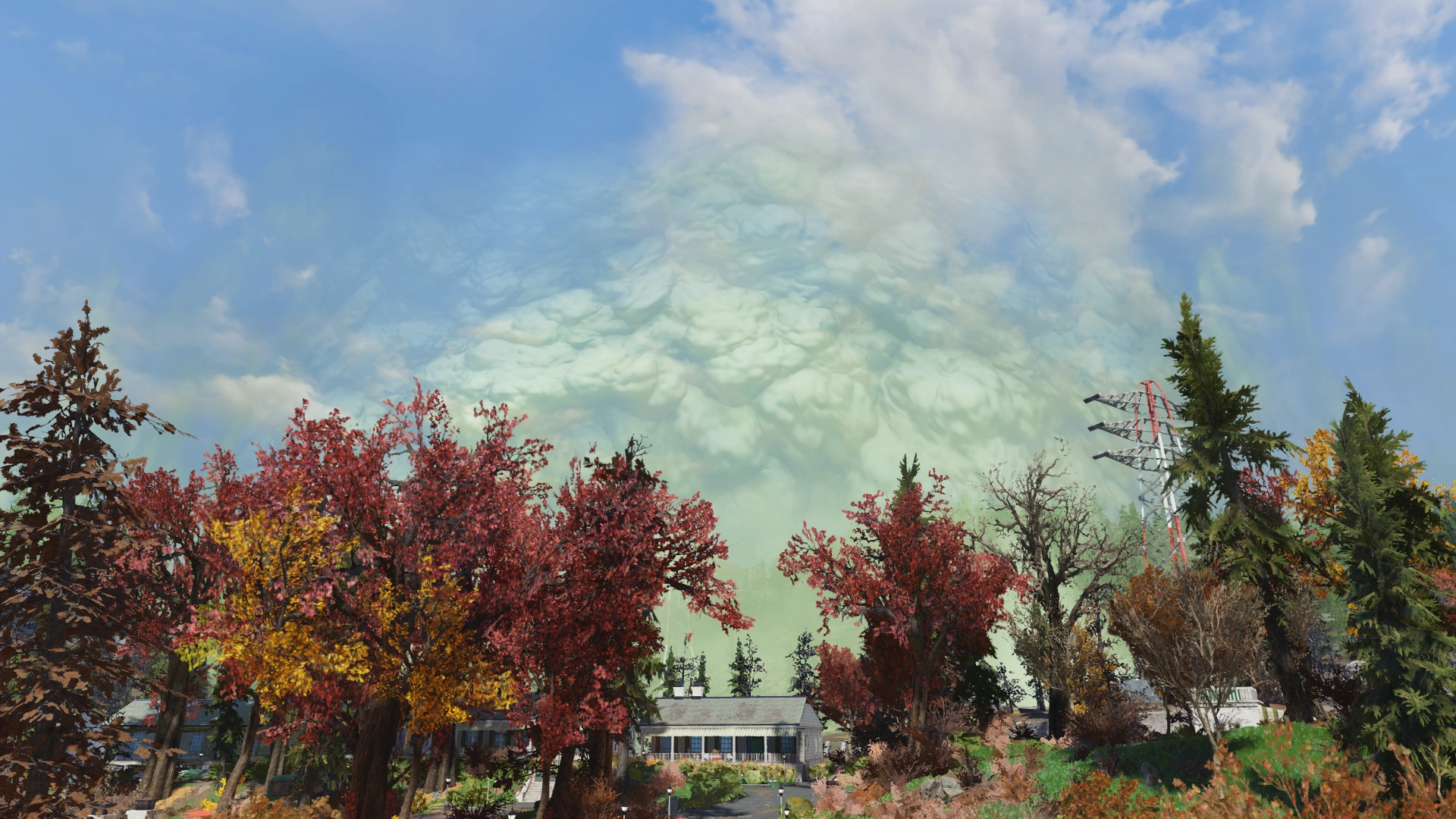
A distant radstorm seen from the Whitespring
Building upon the real-time weather system from Fallout 4, Fallout 76 introduces an improved dynamic lighting model and subsurface scattering to further enhance the cosmetic appearance of weather effects compared to previous games. Unlike Fallout 4, where they were region-wide, rain clouds and radstorms cover only a large portion and can move across the map, allowing them to be seen approaching from a distance.
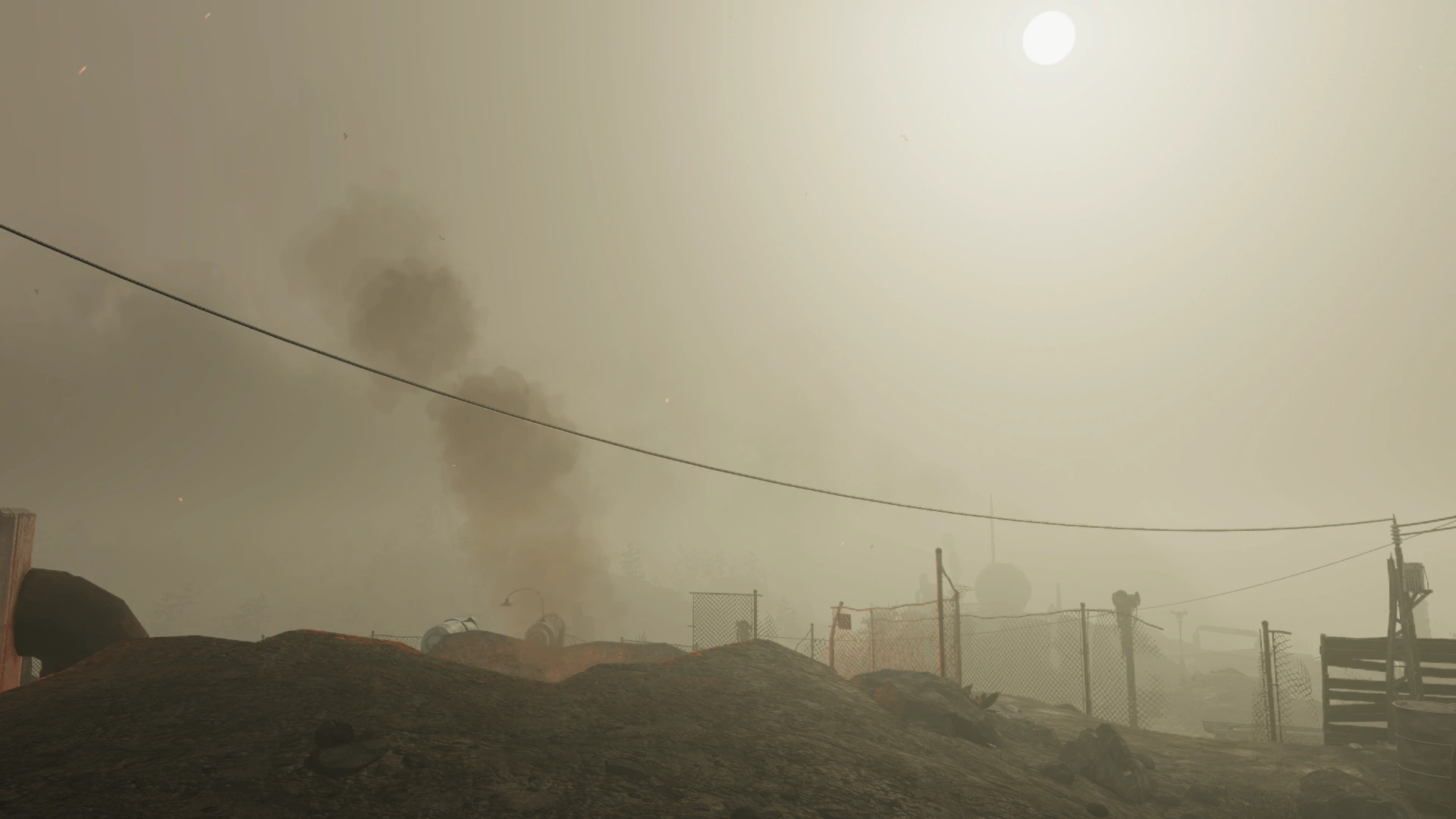
An ash storm near Mount Blair
Some regions of Appalachia feature distinct weather and also chances of distinct weather types occurring. In addition to overcast, fog, and rain, Appalachia is also shown to be affected by ash storms and radioactive dust clouds from the heavy pre-War industrial activity in regions like the Ash Heap and Savage Divide. Ash storms occur within the Ash Heap, primarily near Mount Blair, and involve a heavy gray haze blanketing the area, lowering visibility. This effect is amplified when facing toward the sun and looking outside from interiors.
Weather control is directly related to some plotlines in Fallout 76. Fort Atlas, formerly the ATLAS Observatory, was the site of a defunct military weather control project, with terminal entries noting that it was able to cause "near-whiteout blizzard conditions" in the region in mid-August.[14] Skyline Valley in the south of Appalachia is blanketed in a heavy thunderstorm, with a dark overcast sky and red lightning; this was caused by the activation of Vault 63's weather machine, which also created the Lost, electrically charged ghouls who seem to be able to harness electricity from the storm. Lightning bolts from the storm frequently strike around Dark Hollow Manor, where the storm is centered. Standard weather conditions can also occur in the region.
Unlike the weather change shell introduced in Fallout 4's Contraptions Workshop, players can only directly affect the weather in Appalachia by going to weather control stations. Even then, the weather can only change depending on the type of weather control station used. However, player-triggered nuclear missile launches, also affect the weather around the blast zone formed at the impact site as a side effect. The blast generates large dust clouds, enclosing the zone in a yellow-orange haze with occasional flashes of lightning. The contaminated environment inflicts severe radiation damage without proper protection and can be seen from a distance as a swirling light-brown dust cloud.
Certain unique weather types are found exclusively with Fallout Worlds, such as the Dark Bog and Quantum Storm.
Gallery
Fallout


Fallout 2

Fallout 3


Fallout: New Vegas


Fallout 4


Fallout 76


References
- ↑ ADYTOWNR.MSG - Lines {101}{Adytowner_001} and {110}{Adytowner_010}
- ↑ McJo.msg - Line {190}
- ↑ McFarrel.msg - Line {185}
- ↑ ACMynoc.msg - Line {404}
- ↑ Fallout 2 endings - Modoc
- ↑ Ecfshrmn.msg - Line {105}
- ↑ The Lone Wanderer: "Where can I find Ted Strayer?"
Rivet City security: "Have you tried the common room? That's where he sleeps. Otherwise...hmmm. You can probably find him on the flight deck some days, if it isn't raining. He usually goes to the Muddy Rudder on Sundays. Beyond that, who knows."
(Rivet City Security's dialogue) Note: This dialogue is shared with many other characters in Rivet City. - ↑ Checking out
- ↑ Super mutant: "I like it up here. Nice and cool."
(Super mutants' dialogue) - ↑ Fallen Rock terminal entries; Year: 2078
- ↑ Year: 2078
- ↑ Fallout 4 loading screens: "The Commonwealth is occasionally plagued by radiation storms that blow in from the Glowing Sea, far to the southwest."
- ↑ Far Harbor loading screens: "The island surrounding Far Harbor is covered in a radioactive fog, making all but a few places uninhabitable."
- ↑ ATLAS Observatory terminal entries; Army data analysis terminal, Report [08-20-76]